
What Is IGF-1 LR3? Complete Research Peptide Guide (Structure, Benefits & Stability)
IGF-1 LR3 is a widely studied research peptide known for

Research peptides are short chains of amino acids studied in laboratory environments to understand biological signaling, metabolic pathways, tissue repair, and cellular communication. This guide provides a clear scientific overview for researchers exploring peptide-based studies.
Research peptides are short chains of amino acids that scientists study to better understand biological signaling, metabolic regulation, tissue repair, and cellular communication. Because peptides interact with receptors and pathways that control many biological processes, laboratories extensively use these compounds.
Peptide research has become one of the fastest growing areas in biotechnology and metabolic science due to the precision with which peptides can influence cellular mechanisms.
Learn more about available research peptides
At Elite Research Labs, compounds are supplied strictly for laboratory research purposes only and are not intended for human consumption.
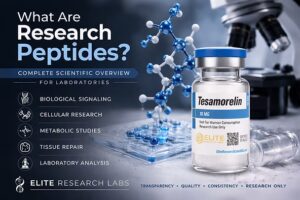
Peptides are molecules made from amino acids linked together through peptide bonds. They are smaller than proteins but still capable of performing complex biological functions within living systems.
Peptides often function as signaling molecules that regulate important biological processes such as the following:
Because of their targeted interactions with receptors, peptides allow researchers to isolate specific biological responses in controlled laboratory environments.
Peptides provide researchers with a way to investigate highly specific biological mechanisms. Their predictable molecular structures allow scientists to examine how cells respond to certain signals and how biological pathways operate.
Researchers commonly study peptides to investigate:
This level of precision makes peptides valuable tools in modern laboratory research and experimental design.
Different classes of peptides are currently being studied in scientific laboratories depending on the biological pathways they interact with.
Some peptides are studied for their interaction with metabolic signaling pathways and incretin receptors.
Examples include Retatrutide and Tirzepatide, both of which are being studied for their role in metabolic research.
Other peptides are studied for their involvement in tissue signaling and cellular repair pathways.
Examples include BPC-157 and TB-500, which are frequently referenced in regenerative research environments.
Copper-binding peptides are another category widely studied in biological research. These peptides interact with extracellular matrix signaling and cellular repair pathways.
One example commonly referenced in research environments is GHK-Cu.
Research peptides are produced using controlled peptide synthesis processes. During synthesis, amino acids are linked together in a specific sequence to replicate naturally occurring peptide structures.
The process typically involves:
Each stage ensures consistency, reproducibility, and accuracy required for laboratory-grade research materials.
Reliable research peptides must be verified through analytical testing methods to ensure accuracy and purity.
Common testing methods include:
These procedures allow laboratories to confirm that the compound being studied matches the expected molecular structure. View detailed lab verification reports in our COA (Certificate of Analysis) database.
All peptides supplied by Elite Research Labs are provided exclusively for laboratory research and scientific investigation.
These materials are not intended for human consumption, medical treatment, or diagnostic use.
Research peptides are used in laboratories to study biological processes such as metabolism, cell signaling, and tissue repair.
No, research peptides are strictly intended for laboratory research and not approved for human consumption.
They are tested using methods like HPLC and mass spectrometry to ensure purity and accuracy.
Research peptides play a critical role in advancing scientific understanding of biological systems. By studying peptide signaling pathways, researchers can gain insights into metabolism, cellular repair, and molecular communication within living organisms.
Explore our full range of research-grade compounds to support your laboratory studies.
As peptide science continues to expand, these compounds will remain essential tools for laboratories investigating complex biological processes.
IGF-1 LR3 is a widely studied research peptide known for

Research peptides can degrade over time, affecting their stability, purity,

Research peptide storage directly impacts stability, purity, and experimental accuracy.

Choosing a reliable source for research peptides is essential to