
Can Research Peptides Go Bad? Signs of Degradation and How to Prevent It
Research peptides can degrade over time, affecting their stability, purity,

IGF-1 LR3 is a widely studied research peptide known for its extended activity, improved stability, and strong interaction with cellular growth pathways. Understanding its structure, mechanism, and handling is essential for accurate and reproducible research outcomes.
IGF-1 LR3 is one of the most widely discussed compounds in peptide research due to its extended activity and strong interaction with cellular growth pathways. In controlled laboratory settings, it has been studied for its role in cell signaling, tissue development, and metabolic processes.
For researchers, understanding IGF-1 LR3 helps improve experimental accuracy and ensures better interpretation of results.
For researchers evaluating peptide quality, stability, and biological interaction, understanding IGF-1 LR3 goes far beyond a simple definition. This guide breaks down the structure, mechanism, and research relevance of IGF-1 LR3—along with what to look for when sourcing high-purity compounds.
Explore high-purity research peptides

IGF-1 LR3 (Insulin-Like Growth Factor-1 Long R3) is a modified version of IGF-1 designed for increased stability and extended activity in research environments.
This modification allows researchers to study prolonged biological activity without rapid peptide breakdown.
Compared to standard IGF-1:
These structural changes enhance bioavailability and extend the peptide’s functional half-life.
IGF-1 LR3 interacts with the IGF-1 receptor (IGF-1R), activating intracellular signaling pathways involved in:
These pathways are essential for studying growth-related cellular responses in controlled environments.
Because of its reduced affinity for binding proteins, IGF-1 LR3 remains more bioavailable in controlled environments compared to native IGF-1.
Higher bioavailability allows for more consistent and measurable research outcomes.
In laboratory settings, IGF-1 LR3 is commonly studied for:
Its extended activity makes it suitable for long-duration experiments and advanced research studies.
Read related peptide research guides (Tesamorelin / Ipamorelin)
One of the defining characteristics of IGF-1 LR3 is its extended half-life, which can last significantly longer than native IGF-1 under controlled conditions.
Extended half-life reduces the need for frequent reapplication in experimental setups.
However, like all peptides, stability depends heavily on:
Proper stability management ensures accurate and repeatable research results.
IGF-1 LR3 is typically supplied in lyophilized (freeze-dried) form to preserve structural integrity.
Lyophilization helps maintain peptide stability during storage and transportation.
Key considerations in research environments include:
Correct handling reduces degradation risks and maintains peptide effectiveness.
Read: Understanding peptide storage and handling guide
When working with IGF-1 LR3, verifying purity and composition is critical.
Researchers should always review:
These verification methods ensure the peptide meets research-grade quality standards.
Check COA reports and verification details
COA verification helps researchers confirm purity, identity, and reliability of peptide batches.
IGF-1 LR3 is often evaluated alongside other peptides involved in growth signaling.
Key differences:
Each peptide has a different role, making them suitable for specific research objectives.
Read comparison: CJC-1295 vs Ipamorelin
IGF-1 LR3 is used to study cell growth, metabolism, and tissue development in laboratory environments.
Structural modifications increase its half-life and reduce binding to proteins.
It should be stored at low temperatures and handled carefully to maintain stability.
IGF-1 LR3 remains a significant compound in peptide research due to its enhanced stability, extended activity, and strong interaction with cellular growth pathways.
Understanding its structure, storage, and sourcing helps researchers achieve reliable and reproducible results.
For researchers, the key factors are not just understanding what IGF-1 LR3 is—but ensuring:
Explore research-grade IGF-1 LR3
Using high-quality peptides improves research accuracy and reduces experimental errors.
Research peptides can degrade over time, affecting their stability, purity,

Research peptide storage directly impacts stability, purity, and experimental accuracy.
Choosing a reliable source for research peptides is essential to
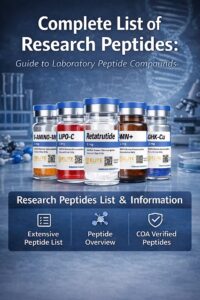
Choosing high-quality research peptides is essential for ensuring accurate results,